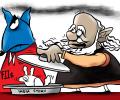
Foreign portfolio investors (FPIs) turned net buyers in October after being net sellers in the previous month. In October, FPIs bought shares worth nearly Rs 8,430 crore ($1 billion) against net selling of Rs 13,405 crore ($1.6 billion) in September. Positive flows during three of the previous four months have pushed the domestic markets towards fresh all-time highs. At present, the Sensex and Nifty are less than 2 per cent shy of breaching record highs logged in October 2021. A rally in equity markets in the US and Europe is in hopes that the Federal Reserve may go soft on rate hikes after its November meeting.

Broadly stagnant sales causes the first drop in business activity in over a year.

Trading in the domestic stock market would be influenced by trends in the global equities, macroeconomic data and foreign fund movement in a holiday-shortened week, analysts said. Markets may face volatile trends on Monday after Federal Reserve Chair Jerome Powell's speech at the Fed's annual economic symposium in Jackson Hole on Friday.
Market sentiment suffered a jolt after other Asian markets closed with widespread losses and European markets dropped in early trade

Investors indulged in buying beaten down blue chips at lower and attractive levels.

The HSBC Emerging Markets Index, a monthly indicator derived from the PMI surveys, remained only just above the neutral threshold of 50.0 in September, signalling muted output growth in emerging markets.
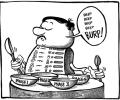
India was already in the midst of a protracted economic slowdown before the virus hit due to a festering crisis among shadow lenders and declining consumer demand and private investment. Service sector activity in India is still effectively on hold.

The broader NSE Nifty closed below the 10,600 mark by plunging 98.15 points, or 0.84 per cent, to 11,582.35 after shuttling between 11,567.40 and 11,751.80.
.jpg)
The HSBC Emerging Markets Index, a monthly indicator derived from the PMI surveys, continued its upward trajectory in November on the back of faster manufacturing growth.
The optimism in global markets could help India as the rebound in GDP is expected to continue and get more broad-based.

Losses largely came from the metal index, followed by power, infrastructure, realty, PSU, oil and gas, capital goods, FMCG, healthcare, auto and banking.

On the job front, Indian service providers continued to add to their payrolls and the sector witnessed the second-strongest increase in employment since March 2011.
Currency scarcity weighed on manufacturing performance where growth of new work flows slowed

The Sensex ended down 134 points at 28,559 and the Nifty ended 35 points lower at 8,554

ICICI Bank was the top laggard in the Sensex pack, sinking over 10 per cent, followed by Bajaj Finance, HDFC, IndusInd Bank, Axis Bank and Maruti. Bharti Airtel and Sun Pharma were the gainers in the BSE index. NSE Nifty suffered a heavy loss of 566.40 points, or 5.74 per cent, to settle at 9,293.50.

The trade impact of the coronavirus epidemic for India is estimated to be about 348 million dollars (approximately Rs 25 billion) and the country figures among the top 15 economies most affected as slowdown of manufacturing in China disrupts world trade, according to a UN report. Estimates published by United Nations Conference on Trade and Development on Wednesday said that the slowdown of manufacturing in China due to the coronavirus (COVID-19) outbreak is disrupting world trade and could result in a 50 billion dollar decrease in exports across global value chains.

Factory growth picked up in May.

Inflation in India probably edged up in October as food prices climbed while weak demand is expected to have hurt factory output growth.

Growth concerns on China, which has already seen the yuan getting devalued twice in August, have rattled global financial markets, including that of India.

The seasonally adjusted India Services Business Activity Index rose sharply from 34.2 in July to 41.8 in August, the highest since March, before the escalation of the pandemic.

On the employment front, services employment was unchanged in April.

The biggest losers in the Sensex pack were Vedanta, Tata Steel, M&M, Tata Motors, Maruti, Hero MotoCorp, PowerGrid, Bharti Airtel, SBI and Coal India -- falling up to 4.48 per cent.

'Retail investors have been selling since the Budget and Foreign Portfolio Investors started selling.' 'Thus far, domestic institutions have picked up the slack, buying enough to keep the major indices from falling off a cliff.' 'However, there has been carnage in smaller stocks and the financial sector has been hit much harder than the major market indices,' points out Devangshu Datta.

The HSBC Emerging Markets Index, a monthly indicator derived from the PMI surveys stood at 52.6 in March, little unchanged from the February reading when it stood at 52.4, indicating a subdued rate of economic growth in global emerging markets.

India's inflation trajectory in the coming months will be influenced more by the geo-political situation due to the war in Europe and its impact on supply chains and commodity prices. However, the country is better placed than most to "weather the storm" and achieve growth of close to 8 per cent in the current fiscal year, the finance ministry said in its latest monthly economic report on Thursday. "Through the channel of imports, elevated global crude and edible oil prices now have a significant impact on India's inflation outlook. "Government measures to keep the prices of these commodities in check, along with the recent hike in policy rates by the RBI, are expected to temper inflationary pressures in the economy," the monthly economic report for April, drafted by the finance ministry's economic division, said.

The NSE Nifty also moved up by 12 points to 8,648.35.
.jpg)
The HSBC Emerging Markets Index, a monthly indicator derived from the PMI surveys, sank to 50.6 in June from 51.3 in May, signalling the weakest increase in output since May, 2009.

The Nikkei India Services PMI posted above the critical 50.0 level, which separates growth from contraction, for the fourth month running in May.
The Nikkei India Services Purchasing Managers' Index (PMI), which tracks services sector firms on a monthly basis, stood at 48.7 in January, as against 46.8 in December 2016.
Stock markets are expected to remain under pressure this week due to the overhang of US presidential polls and uncertainty over global growth due to resurging cases of coronavirus, according to analysts.

Indian economy is expected to grow 10.5 per cent or more in the current fiscal, Niti Aayog Vice Chairman Rajiv Kumar said on Thursday. Speaking at a virtual conference organised by the Public Affairs Forum of India (PAFI), he also said that modernisation of the retail sector is very much on the cards. "India Purchasing Managers' Index (PMI) for both manufacturing and services has shown a very smart uptick last month. "This (Indian economy) will strengthen even further," he said. "I expect Indian economy to grow 10.5 per cent or higher in FY 22," he noted.

Business confidence remained positive in August and was driven by upbeat forecasts of sales, an expected improvement in demand and promotional activities
Marking its quickest rise in over seven years, India's services sector activity expanded for the fifth successive month in February, tracking spike in business orders, renewed export demand and strengthening business confidence, a monthly survey showed on Wednesday. The IHS Markit India Services Business Activity Index rose from 55.5 in January to 57.5 in February. This is the fastest expansion in services output since January 2013.

The recovery in the Indian services sector was sustained in November as new work orders supported business activity growth and the first rise in employment in nine months, a monthly survey said on Thursday.

A reading above 50 indicates expansion while a one below this level means contraction.

India's services sector activity surged to a seven-year high in January driven by sharp increase in new business orders, leading to job creation and business optimism amid favourable market conditions, a monthly survey said on Wednesday. The IHS Markit India Services Business Activity Index rose from 53.3 in December to 55.5 in January, signalling the strongest upturn in output in seven years.

Private sector output in India expanded for the first time in 8 months in February as slump in the services sector moderated and manufacturing grew at a stronger pace, an HSBC survey said.

India's services sector activity expanded at a slower pace in December as rates of growth in sales eased to a three-month low and staff hiring came to a halt amid weak business optimism, a monthly survey said on Wednesday. The seasonally adjusted India Services Business Activity Index fell from 53.7 in November to 52.3 in December. The index was above the critical 50 mark that separates growth from contraction for the third month in a row during December, but pointed to the slowest pace of expansion in the three-month sequence.
The survey noted that advertising campaigns supported the increase in new work growth in the sector amid competitive pressures.
